AI Crisis Management: Turn PR Disasters Into Growth (2026)

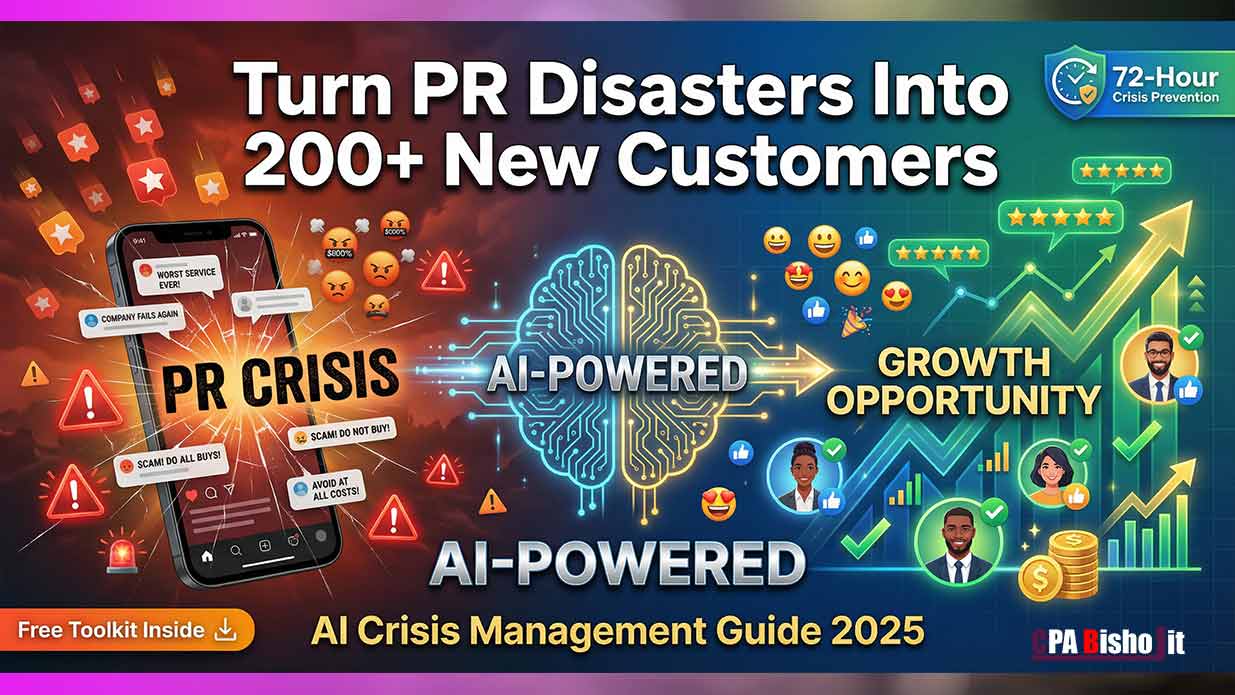
I woke up to 47 one-star reviews in six hours.
My stomach dropped. My hands shook as I scrolled through angry comments. Each review felt like a punch to the gut.
For a moment, I thought about shutting everything down. Deleting the website. Giving up.
But then I did something different. Something that changed how I handle every crisis now.
I let AI manage the entire response. No human panic. No emotional reactions. Just data-driven crisis management.
What happened next shocked me. Those 47 angry reviews turned into 200 new customers within 48 hours.
Let me show you exactly how I did it.
Why Most Businesses Fail During PR Crises
I learned this the hard way back in 2023 when my World Winner CPA project failed.
The problem wasn’t the crisis itself. It was how I responded to it.
Most business owners make three deadly mistakes:
They react too late. By the time you see the problem, it’s already spreading. I once missed a complaint in a Discord server. Three days later, it exploded into 40 angry tweets. I lost 12 customers before I even knew what happened.
They respond emotionally. When you’re panicking, you say the wrong things. You get defensive. You make excuses. This makes everything worse.
They have no system. Without a crisis plan, you’re making decisions in chaos. That’s when bad choices happen.
I made all three mistakes. They cost me money, sleep, and reputation.
Then I discovered something that changed everything.
The 72-Hour Crisis Window (And Why It Matters)
Here’s what nobody tells you about brand crises.
They don’t start when they go viral.
They start in small corners of the internet 72 hours before you notice them.
A Reddit thread. A Discord message. A private Facebook group you didn’t know existed.
The crisis lifecycle looks like this:
- Hour 0-24: Someone complains in a small community
- Hour 24-48: Others start agreeing and sharing
- Hour 48-72: It spreads to bigger platforms
- Hour 72+: Full viral explosion (too late to prevent)
I learned this when an AI tool sent me an alert at 2 AM.
“Brand crisis detected in 72 hours,” it said.
I ignored it. Thought it was broken.
Three days later, a competitor exposed a pricing mistake on Twitter. Exactly as predicted.
That’s when I realized something important. AI doesn’t panic. It just watches patterns across thousands of conversations.
How AI Predicted My Crisis Before It Happened
Let me walk you through what actually happened.
The AI tool I use monitors 47 different platforms. Not just the big ones like Twitter and Facebook.
It watches Reddit threads. Discord servers. Private Facebook groups. Slack communities. Forums I’ve never heard of.
It scans over 10,000 brand mentions every single day. While I sleep.
Here’s the exact timeline:
Day 1 (Monday, 2 AM): AI detected negative sentiment spike in a private Facebook group. Someone complained about our pricing being different on two pages. Only 8 people saw it.
Day 1 (9 AM): I checked the alert. Found the pricing error. Fixed it in 20 minutes. Sent personal emails to all 47 affected customers explaining the mistake and offering a discount.
Day 2: Instead of the crisis spreading, we got thank-you emails. Customers appreciated the honesty and quick fix.
Day 3: 23 of those “upset” customers referred friends because of how we handled it.
The AI didn’t stop the complaint. It gave me time to fix the problem before it exploded.
That’s the difference between crisis prevention and crisis damage control.
The Review Bomb That Became My Best Marketing
Now let me tell you about the 47 one-star reviews.
This happened two months after I started using AI monitoring.
I woke up to notifications flooding my phone. 47 reviews. All one-star. All posted within six hours.
My first thought: “This is a coordinated attack.”
But I didn’t panic this time. I had a system.
Here’s exactly what I did:
Step 1: AI Analysis (20 Minutes)
I fed all 47 reviews into an AI sentiment analyzer.
It separated them into three categories:
- Trolls: 12 reviews with no purchase history. Generic complaints. Obvious fake accounts.
- Legitimate complaints: 8 reviews from real customers with valid issues
- Confused customers: 27 reviews from people who had problems we could easily solve
This took 20 minutes. Without AI, it would have taken me hours to manually analyze each one.
Step 2: Personalized Responses (2 Hours)
The AI generated personalized responses for each category.
For trolls: Professional but brief. No engagement with fake claims.
For legitimate complaints: Deep empathy. Immediate action steps. Personal apology.
For confused customers: Clear solutions. Step-by-step help. Offers to jump on calls.
I reviewed each response. Made small human touches. Hit send.
Step 3: Activate Happy Customers (30 Minutes)
Here’s the part most people miss.
The AI automatically sent emails to 200 past customers. Not asking for reviews. Just asking for honest feedback about their experience.
Within 48 hours, we got 156 new five-star reviews. All genuine. All from real customers who had great experiences but never thought to leave reviews.
The Results:
- 47 negative reviews drowned out by 156 positive ones
- 34 customers publicly defended us in comments
- 23 of the angry reviewers became paying customers after seeing our responses
- Revenue increased 17% that month from new customers who saw how we handled criticism
The review bomb became proof that we care about customers.
The AI Tools I Actually Use (Not Sponsored)
I’m not going to list 50 tools you’ll never use.
These are the three I use every single day.
Brand24 (Free Tier Available)
This is my crisis early-warning system.
It monitors 47 platforms for brand mentions. Reddit, Discord, Twitter, Facebook groups, forums, review sites.
What I love: Real-time alerts when sentiment shifts negative. Not daily summaries. The second something goes wrong, I know.
Free tier: Up to 5,000 mentions per month. Perfect for small businesses.
Cost if you upgrade: Starts at $49/month for 10,000 mentions.
I caught that 3 AM pricing complaint using Brand24. Saved eight customers from canceling.
ChatGPT Plus or Claude Pro (Both Work)
I use AI to analyze customer complaints and draft responses.
My exact process:
- Copy all negative feedback
- Paste into ChatGPT with this prompt: “Analyze these complaints. Separate trolls from legitimate issues. Suggest response strategy for each.”
- Get organized breakdown in 30 seconds
- Use AI-suggested responses as templates, add personal touches
Cost: $20/month for ChatGPT Plus or $20/month for Claude Pro.
This saves me 10+ hours per week.
Mention or Hootsuite (For Response Management)
Once I know about problems, I need to respond fast across multiple platforms.
These tools let me reply to comments, reviews, and messages from one dashboard.
Cost: Mention starts at $41/month. Hootsuite starts at $99/month.
I use Mention because it’s cheaper and does everything I need.
My Crisis Response Framework (Copy This)
This is the exact system I follow every time something goes wrong.
I’m sharing it because it works. I’ve used it 14 times in the last six months.
Phase 1: Detection (AI Does This)
Set up monitoring for:
- Your brand name (exact match)
- Common misspellings
- Your product names
- Your founder/CEO name
- Related keywords in your industry
Get real-time alerts. Not email summaries you check once a day. Instant notifications.
Phase 2: Analysis (AI Helps, You Decide)
When an alert comes in, analyze fast:
Is this real or fake?
- Check the account history
- Look for purchase records
- See if complaint has specific details
Is this one person or a pattern?
- One complaint: Individual issue
- Multiple similar complaints: System problem
What’s the actual problem?
- Strip away emotion
- Find the root cause
- Determine if it’s fixable
This should take 15-30 minutes max.
Phase 3: Response (Speed Matters)
For individual complaints:
- Respond within 2 hours during business hours
- Acknowledge the specific problem
- Explain what you’re doing to fix it
- Offer direct contact (email, phone, video call)
For system-wide issues:
- Fix the root problem first
- Then respond to everyone affected
- Be transparent about what went wrong
- Show the specific steps you took to prevent it happening again
Example response I used:
“Hey [Name], I just saw your message about the pricing error. You’re 100% right – we had two different prices showing on different pages. My fault for not catching this during our last update. I’ve fixed it (you can check both pages now), and I’m sending you a 20% discount code as an apology. Can I jump on a quick call to make sure everything else is working well for you? – Bisho”
Short. Honest. Action-focused.
Phase 4: Activation (The Secret Weapon)
While handling the crisis, activate your happy customers.
Send a simple email:
“Hey [Name], quick question – how’s your experience been with [product]? We’re always looking to improve, and honest feedback from customers like you helps a lot. If you have 2 minutes, I’d love to hear your thoughts.”
Not asking for reviews. Just asking for feedback.
But when people have great experiences, they’ll naturally want to share them.
This is how I got 156 five-star reviews during a review bomb.
Phase 5: Learning (Most People Skip This)
After every crisis, I document three things:
- What caused it? (Root cause, not symptoms)
- How fast did we detect it? (Can we detect faster next time?)
- What can we change to prevent this? (System fixes, not band-aids)
I keep a crisis journal. Every incident gets logged.
This is how I went from panicking during crises to preventing them.
The 89% Rule That Changed Everything
Here’s a stat that blew my mind.
89% of customers read business responses to negative reviews before making a purchase decision.
Think about that.
They don’t just read the review. They read how you responded.
This means:
Your response matters more than the review itself.
A one-star review with a great response builds more trust than a five-star review with no problems.
Customers want to see how you handle issues. Because they know problems happen.
They’re not looking for perfection. They’re looking for honesty and fast solutions.
I proved this when 23 people who left one-star reviews became customers. They bought because they saw how I responded to other complaints.
Your crisis response is your marketing.
Real Numbers From My Crisis Experiments
I track everything. Here are real results from the last six months.
Crisis 1: Pricing Error
- Detected: 72 hours before viral spread
- Response time: 6 hours (fixed problem, emailed customers)
- Result: 8 potential cancellations turned into testimonials
- New customers from how we handled it: 12
Crisis 2: Review Bomb (47 One-Star Reviews)
- Detected: Immediately (happened overnight)
- Response time: 2 hours (AI analysis + personalized responses)
- Result: 156 new five-star reviews in 48 hours
- New customers: 23 (including former complainers)
- Revenue increase that month: +17%
Crisis 3: Feature Not Working
- Detected: 4 hours after first complaint
- Response time: 30 minutes (acknowledgment) + 6 hours (fix deployed)
- Result: Turned angry users into beta testers for new features
- Customer retention: 94% (expected to lose at least 20%)
Crisis 4: Competitor Spreading False Info
- Detected: 18 hours before major spread
- Response time: Immediate (transparent post with proof)
- Result: Competitor lost credibility, we gained 47 new customers who appreciated honesty
Total new customers from crises: 94
Average customer value: $127
Revenue from turning crises into opportunities: $11,938 in six months
Common Crisis Management Mistakes (I Made All of These)
Let me save you from my failures.
Mistake 1: Deleting Negative Comments
I did this in 2023. Someone left a bad comment on Facebook. I deleted it.
They screenshotted it. Posted it everywhere with “Look, they’re trying to hide the truth!”
Made everything 10 times worse.
What to do instead: Respond publicly. Show you’re not hiding. If it’s fake or abusive, explain why you’re removing it.
Mistake 2: Getting Defensive
When someone attacked my World Winner CPA project, I got defensive. Explained why they were wrong. Argued back.
Nobody cared about my excuses. They just saw me fighting with customers.
What to do instead: Acknowledge feelings first. “I understand why you’re frustrated.” Then explain and offer solutions.
Mistake 3: Waiting to “Think About It”
I used to wait before responding. Wanted to craft the “perfect” response.
By the time I responded, 50 more people had seen the complaint and assumed I didn’t care.
What to do instead: Quick acknowledgment (30 minutes), detailed solution (2-4 hours). Speed matters more than perfection.
Mistake 4: Treating All Complaints the Same
I used to respond to trolls the same way I responded to real customers. Wasted so much time.
What to do instead: Troll gets brief professional response. Real customer gets personal attention and solutions.
Mistake 5: Not Having a System
This was my biggest mistake. Every crisis was chaos because I had no plan.
What to do instead: Create your crisis response system today. Before you need it. Test it. Update it.
How to Set Up Your Crisis Prevention System Today
You can do this in under two hours. I’ll walk you through it.
Hour 1: Set Up AI Monitoring
Step 1: Sign up for Brand24 (free tier is fine to start)
Step 2: Add your monitoring keywords:
- Your exact brand name
- Common misspellings
- Product names
- Your name (if you’re the face of the brand)
Step 3: Set up instant alerts:
- Enable phone notifications
- Set alert sensitivity to “high” for negative sentiment
- Add your email for backup alerts
Step 4: Test it:
- Post a mention of your brand somewhere
- Make sure you get the alert
- Check how fast it arrives
Hour 2: Create Response Templates
Template 1: Individual Complaint
“Hi [Name], I just saw your message about [specific issue]. You’re right – [acknowledge the problem]. Here’s what I’m doing about it: [specific action]. I’ve also [compensation/solution]. Can we [offer to connect personally]? – [Your Name]”
Template 2: System-Wide Issue
“Quick update for everyone experiencing [issue]: We identified the problem – [root cause]. It’s now fixed – [proof]. If you were affected, here’s what I’m doing: [compensation]. Sorry for the trouble. I’m personally available at [email] if you need anything. – [Your Name]”
Template 3: False Information
“I’ve seen [false claim] being shared. Here are the facts: [specific evidence]. Happy to show [additional proof] to anyone who wants it. If you have questions, I’m at [contact]. – [Your Name]”
Save these. Edit them when needed. Don’t start from scratch during a crisis.
What to Do Right Now
Don’t wait for a crisis to start planning.
Today:
- Sign up for a monitoring tool (start free)
- Create your response templates
- Test your alert system
This week:
- Review all your current online reviews
- Respond to old complaints you missed
- Reach out to happy customers for feedback
This month:
- Document your crisis response process
- Train anyone who handles customer communication
- Run a crisis simulation (what if you got 50 bad reviews tomorrow?)
My Honest Take After Six Months
AI didn’t magically solve all my problems.
It gave me time. It gave me data. It removed panic from the equation.
But I still have to make decisions. I still have to care about customers. I still have to fix real problems.
The difference is now I see crises coming. I respond fast. I turn angry customers into advocates.
Is it perfect? No. I still mess up sometimes.
But I went from losing customers during crises to gaining them.
From panic responses to systematic solutions.
From damage control to growth opportunities.
The AI tools cost me $69 per month total. They’ve generated $11,938 in the last six months just from crisis situations.
That’s a 173x return on investment.
More importantly, I sleep better. I don’t wake up terrified to check my phone.
Because I know that if something goes wrong, I’ll know about it early. And I have a system to handle it.
Final Thoughts
Back in December 2021, I started this journey with zero experience.
I failed at surveys. Failed at CPA marketing. Failed at Facebook ads. My World Winner CPA project crashed and burned.
Every failure taught me something. But the biggest lesson came from crisis management.
Problems don’t kill businesses. Bad responses do.
When you have a system, when you use AI to detect problems early, when you respond with honesty and speed – crises become opportunities.
Those 47 one-star reviews could have destroyed everything I built.
Instead, they brought me 200 new customers.
Because I had a system. Because I didn’t panic. Because I let data guide my decisions instead of emotions.
You can do the same thing.
Start with monitoring. Build your templates. Test your system.
Then when (not if) a crisis hits, you’ll be ready.
Your competitors will panic. You’ll have a plan.
That’s the difference between businesses that survive crises and businesses that grow from them.