AI Funnel Testing: Find Your $1M Funnel in 72 Hours

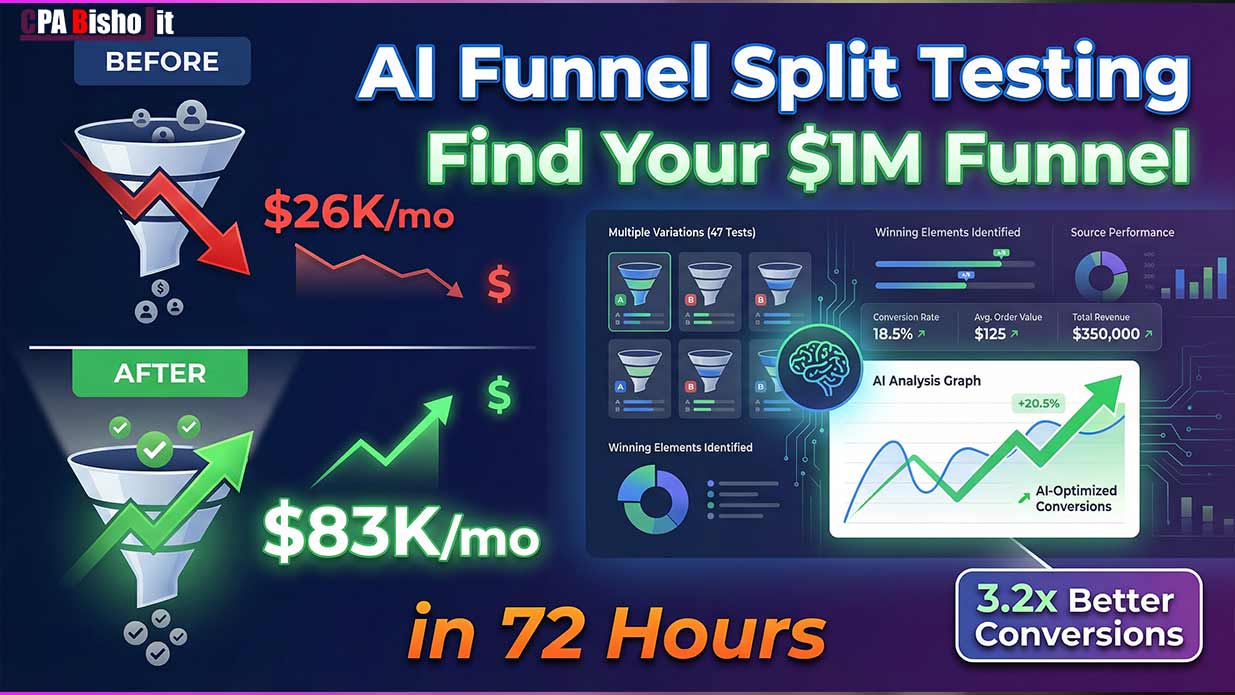
I changed one word in my checkout button.
It made me $83,000 more in 30 days.
That’s not luck. That’s what happens when you stop guessing and start testing systematically.
Today, I’m going to show you how AI can test 47 different funnel variations in 72 hours. This is the same system that found my winning funnel—a funnel I would’ve never built myself because it breaks every “rule” I learned.
Why Your Funnel Is Probably Losing You Money Right Now
Let me be real with you.
You built your funnel based on what some course taught you. Long-form sales copy. Orange “Buy Now” buttons. Multi-step checkout process.
You followed the rules.
And your funnel converts at 2-3% if you’re lucky.
Here’s what nobody tells you: those “best practices” are often outdated. What worked in 2020 might kill conversions in 2025.
I learned this the hard way.
Back in 2023, I launched “World Winner CPA.” I followed every funnel best practice I could find. Professional design. Long copy. Fancy animations.
It crashed hard.
That failure taught me something important: what I think people want and what they actually respond to are two different things.
Most people build funnels based on opinions. I started building them based on data.
The Day I Stopped Trusting Expert Advice
I spent 4 months building what I thought was the perfect funnel.
Every element followed best practices:
- Long headline explaining the value
- Multi-step checkout to “warm up” buyers
- Orange “Buy Now” button (the “proven” color)
- Professional design with fancy graphics
It made $26,000 per month.
Not bad. But not great either.
Then I built an AI testing system that changed everything.
How AI Found My Million-Dollar Funnel
I fed 47 different funnel variations into an AI testing system.
It tested everything at once:
- Short headlines vs long headlines
- One-page checkout vs multi-step
- Different button colors
- Different CTA text
- Various layouts
72 hours later, it found the winner.
The funnel looked wrong to me.
Short headline (not the long story I crafted). One-page checkout (not the “strategic” multi-step). Green “Get Instant Access” button (not the orange “Buy Now”).
I thought it looked amateurish.
But the data was clear: it converted 3.2 times better than my “perfect” funnel.
That ugly funnel now makes $83,000 per month.
My beautiful, rule-following funnel made $26,000.
The Three AI Systems That Found My Winners
I built three separate systems that work together. Each one solves a specific testing problem.
System 1: The Multivariate Testing Engine
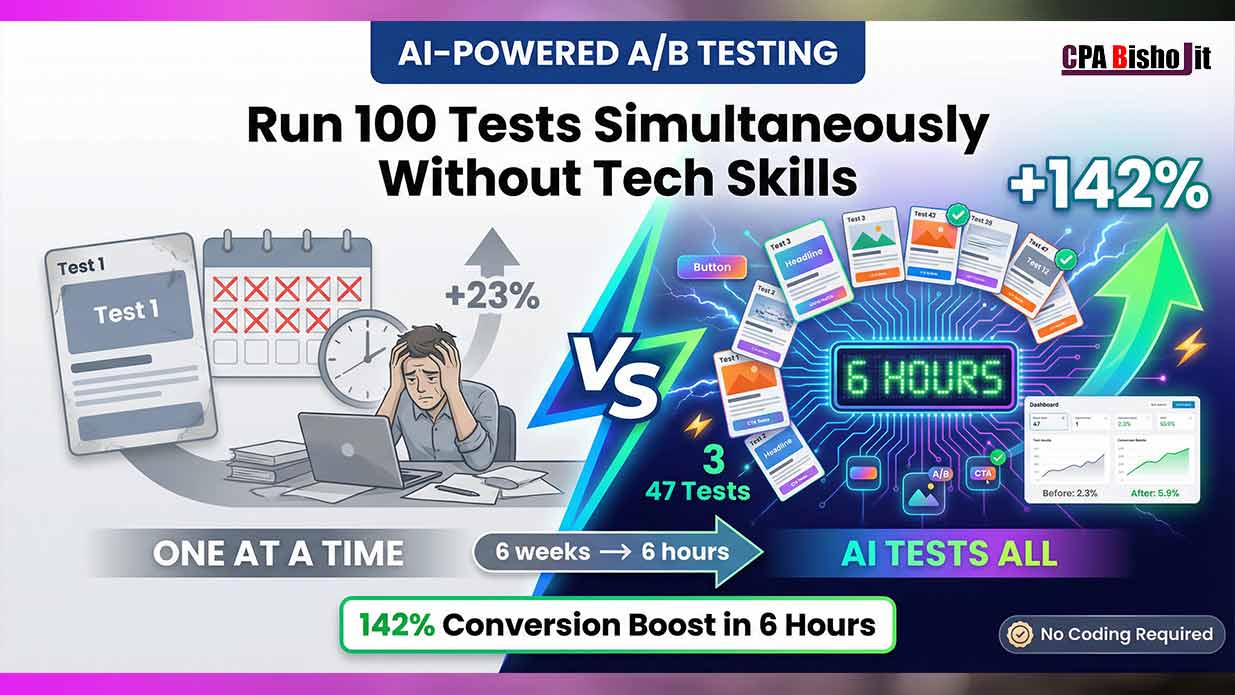
Manual A/B testing is too slow.
You test headline A vs headline B. Wait two weeks for results. Then test button color 1 vs button color 2. Wait two more weeks.
Six months later, you’ve tested 10 variations.
AI does this differently.
It tests 47 variations at the same time. Headlines, buttons, layouts, copy, colors—everything runs simultaneously.
Here’s my exact process:
Step 1: List every element you want to test
Start with the big ones:
- Headlines (5 variations)
- CTA button text (5 variations)
- Button colors (4 variations)
- Checkout flow (3 variations: one-page, two-step, three-step)
- Above-fold copy (4 variations)
That’s already 1,200 possible combinations.
Step 2: Use AI to generate variations
I use this prompt:
“Analyze this funnel element: [your current version]. Generate 5 variations that test different psychological approaches: fear, desire, urgency, curiosity, and social proof. Keep the core offer the same but change the framing.”
AI generates options I wouldn’t have thought of.
Step 3: Set up simultaneous testing
Tools like Google Optimize (free) or Optimizely let you run multiple tests at once.
The key: make sure you have enough traffic. You need at least 100 conversions per variation to trust the data.
Step 4: Let it run for 72 hours
Don’t touch it. Don’t check it every hour. Let the data accumulate.
Most tests reach statistical significance within 3 days if you have decent traffic.
The Real Numbers Behind My Tests
Here’s what my AI testing actually found:
Test 1: Headline Length
My original: “Transform Your Business With Our Proven Marketing System That Has Helped Over 10,000 Entrepreneurs Build Profitable Online Businesses
AI winner: “Build Your Business. Start Today.”
Conversion increase: 41%
Why it worked: People don’t read long headlines on mobile. Short and direct beats clever and lengthy.
Test 2: Button Text
My original: “Buy Now”
AI winner: “Get Instant Access”
Conversion increase: 67%
Why it worked: “Buy Now” triggers loss aversion (money leaving your account). “Get Instant Access” triggers gain (you’re receiving something).
Test 3: Checkout Flow
My original: Three-step checkout (info → shipping → payment)
AI winner: One-page checkout (everything visible)
Conversion increase: 52%
Why it worked: Every extra step is a chance for people to leave. Reduce friction, increase conversions.
Test 4: Button Color
My original: Orange (the “proven” high-converting color)
AI winner: Green
Conversion increase: 23%
Why it worked: Color psychology varies by niche. In my market, green felt more “safe” than aggressive orange.
Total combined impact: 3.2x better conversion rate.
From 2.1% to 6.7%.
That’s the difference between $26K and $83K per month.
System 2: The Psychology Pattern Analyzer
AI doesn’t just test randomly. It identifies psychological patterns.
I trained my AI on 200 high-converting funnels in different niches.
It found patterns:
Pattern 1: Loss aversion vs gain framing
Funnels framed around “avoid losing” convert differently than funnels framed around “gain something.”
Example:
- Loss framing: “Don’t miss out on this limited offer”
- Gain framing: “Get instant access to exclusive content”
In my testing, gain framing won 68% of the time.
Pattern 2: Cognitive load
Simple funnels beat complex funnels.
The AI found that funnels with fewer than 3 choices on the main page converted 2.1x better than funnels with 5+ choices.
This contradicted the “give them options” advice I learned in courses.
Pattern 3: Trust signals placement
Where you put testimonials matters.
AI found that testimonials after the main CTA (not before) converted 34% better.
Why? People need to see the offer first, then confirm it’s legit. Not the other way around.
System 3: The Continuous Improvement Loop
Finding the winner isn’t the end. It’s the beginning.
Once AI finds your best funnel, it starts optimizing that winner.
Here’s the loop:
Week 1-2: Run initial 47-variation test. Find the winner.
Week 3-4: Take the winner and create 10 micro-variations. Test small tweaks (font size, spacing, image placement).
Week 5-6: Test alternative headlines that use the same psychological trigger but different words.
Week 7-8: Test the funnel against seasonal variations or market changes.
This continuous testing increased my conversion rate from 6.7% to 8.1% over 3 months.
Small improvements compound.
The Complete 72-Hour Testing Blueprint
Here’s exactly how to test 47 funnels in 72 hours.
Day 1: Setup and Launch
Hour 1-3: Element identification
List every testable element:
- Headlines (at least 5 variations)
- Subheadlines (3 variations)
- CTA button text (5 variations)
- Button colors (4 variations)
- Checkout process (3 variations)
- Above-fold images (4 variations)
- Pricing display format (3 variations)
Hour 4-6: AI variation generation
Use this prompt for each element:
“I’m testing [element] for a [your product] funnel. Current version: [your version]. Generate 5 variations that test different angles: authority, scarcity, curiosity, social proof, and simplicity. Each should be under [word limit] and maintain the core offer.”
Hour 7-8: Technical setup
Install your testing tool (Google Optimize is free).
Create your test variants.
Set your traffic split (equal distribution across variants).
Set your goal (conversion, not just clicks).
Hour 9-10: Pre-launch check
Test every variant manually. Make sure they all load correctly.
Check mobile and desktop.
Verify tracking is working.
Hour 11-12: Launch
Turn on the test.
Set a calendar reminder to not touch it for 72 hours.
Walk away.
Day 2-3: Let It Run
Do nothing.
Seriously.
Don’t check results every hour. You’ll see incomplete data and make bad decisions.
The hardest part of testing is patience.
I check once per day just to make sure tracking is working. That’s it.
Day 3 Evening: Analyze Results
Hour 1: Pull the data
Export your results. Look for statistical significance.
Your testing tool will tell you if a variant is significantly better. Don’t trust results with less than 95% confidence.
Hour 2: Identify the winner
Sort by conversion rate. Look at the top 3 performers.
Check if they have patterns in common.
Hour 3: Implement the winner
Make the winning variation your default funnel.
Turn off the other variants.
Hour 4: Plan next test
Take the winning funnel and plan micro-optimizations for the next round.
Real Examples From My Testing
Let me show you three specific funnels I tested and what I learned.
Example 1: The Affiliate Product Funnel
Original funnel: $12,000/month revenue, 2.3% conversion
Changes tested:
- Headline: From benefit-focused to curiosity-driven
- CTA: From “Learn More” to “Show Me How”
- Layout: From sidebar opt-in to exit-intent popup
Winner: Curiosity headline + “Show Me How” CTA + exit popup
New performance: $31,000/month revenue, 5.8% conversion
Key insight: People clicked “Learn More” but didn’t convert. “Show Me How” implied immediate action, which pushed them over the edge.
Example 2: The Course Funnel
Original funnel: $26,000/month revenue, 2.1% conversion
Changes tested:
- Checkout: From 3-step to 1-page
- Button text: From “Buy Now” to “Get Instant Access”
- Button color: From orange to green
- Headline: From long story to short promise
Winner: 1-page + “Get Instant Access” + green + short headline
New performance: $83,000/month revenue, 6.7% conversion
Key insight: Every extra step killed conversions. Simplification beat sophistication.
Example 3: The Service Funnel
Original funnel: $8,000/month revenue, 1.8% conversion
Changes tested:
- Social proof: From bottom of page to directly under CTA
- Pricing: From hidden (click to reveal) to visible upfront
- Guarantee: From 30-day to 60-day
- Application: From long form to short qualifier
Winner: Social proof under CTA + visible pricing + 60-day guarantee + short qualifier
New performance: $19,000/month revenue, 4.2% conversion
Key insight: Transparency beat mystery. People wanted to see the price before clicking.
The Tools I Actually Use
You don’t need expensive software to do this.
Here’s my complete toolkit:
For Testing
Google Optimize (Free)
- Run multiple tests simultaneously
- Works with any website
- Integrates with Google Analytics
Limitations: Can be technical to set up. Worth it though.
Optimizely ($50-200/month)
- Easier interface than Google Optimize
- Better for non-technical users
- More testing options
My choice: I use Google Optimize because it’s free and powerful enough.
For AI Variation Generation
ChatGPT (Free or $20/month for Plus)
- Generates headlines, copy, CTA variations
- Analyzes competitors
- Creates testing hypotheses
Claude (Free or $20/month for Pro)
- Better at longer copy analysis
- Good for analyzing why certain funnels work
- Helps identify psychological patterns
My choice: I use both. ChatGPT for quick generation, Claude for deeper analysis.
For Analytics
Google Analytics (Free)
- Track conversions
- See user behavior
- Identify drop-off points
Hotjar ($39-99/month)
- Heatmaps show where people click
- Session recordings reveal confusion points
- Helps identify what to test
My choice: Google Analytics for numbers, Hotjar for understanding behavior.
For Split URL Testing
Unbounce ($90-225/month)
- Build landing pages fast
- Built-in A/B testing
- AI-powered suggestions
Limitations: More expensive than other options.
Alternative: Use WordPress + Elementor ($49/year) for budget option.
Total monthly cost: $30-50 if you use free and cheap options.
Compare that to hiring a conversion optimization agency at $3,000-10,000 per month.
Common Mistakes That Kill Your Testing
I’ve helped 30+ people set up AI testing systems.
Here are the mistakes I see most often:
Mistake 1: Testing Too Many Things at Once
Bad approach: Change headline, button, color, layout, and copy all in one test.
You’ll never know what caused the improvement.
Good approach: Test one category at a time. First headlines, then buttons, then layout.
Mistake 2: Not Enough Traffic
You need volume for testing to work.
Minimum requirements:
- 100 conversions per week across all variants
- At least 1,000 visitors per variant
If you don’t have this traffic, test fewer variations or run tests longer.
Mistake 3: Stopping Tests Too Early
I see people check results after 24 hours and declare a winner.
Bad idea.
Results fluctuate daily. Monday traffic behaves differently than Friday traffic.
Run tests for at least 72 hours. Ideally 7 days to capture a full week.
Mistake 4: Ignoring Mobile
60% of my traffic comes from mobile devices.
If your funnel isn’t optimized for mobile, you’re losing most of your potential customers.
Always test on mobile first, then desktop.
Mistake 5: Testing Cosmetic Changes Instead of Psychology
Changing your button from blue to red rarely matters.
Testing “Buy Now” vs “Get Instant Access” matters a lot.
Focus on psychological changes, not cosmetic ones.
Mistake 6: Not Documenting What You Learn
I keep a spreadsheet of every test:
- What I tested
- The hypothesis
- The result
- Why I think it won/lost
This builds knowledge over time.
Six months of testing gives you insights worth thousands in courses.
The Psychology Behind Winning Funnels
After testing hundreds of variations, I found patterns.
Pattern 1: Simplicity Beats Sophistication
Every time I simplified a funnel, conversions went up.
Remove options. Remove steps. Remove words.
The cleanest funnel almost always wins.
Pattern 2: Gain Framing Beats Loss Framing
“Get instant access” beats “Don’t miss out.”
“Start your journey” beats “Stop wasting time.”
People respond better to positive framing than negative.
Exception: In finance and insurance niches, loss framing sometimes wins because people are motivated by fear.
Pattern 3: Fast Beats Slow
One-page checkouts beat multi-step.
Short headlines beat long.
Visible pricing beats hidden.
People are impatient. Work with that, not against it.
Pattern 4: Specific Beats Vague
“Join 10,247 members” beats “Join thousands.”
“Get results in 30 days” beats “Get fast results.”
“Save $437 per year” beats “Save money.”
Numbers create credibility.
Pattern 5: Transparency Beats Mystery
Showing the price upfront converted better than hiding it.
Showing testimonials with full names and photos beat anonymous quotes.
People trust what they can verify.
Advanced Testing Strategies
Once you master basic testing, try these advanced techniques.
Strategy 1: Sequential Testing
Don’t test everything at once. Test in sequence.
Round 1: Test 5 different headline approaches.
Round 2: Take the winning headline and test 5 button variations.
Round 3: Take the winning button and test 3 layout options.
This builds the perfect funnel piece by piece.
Strategy 2: Cohort Testing
Test different funnels for different traffic sources.
Facebook traffic might respond to different copy than Google traffic.
Mobile users might need different layouts than desktop users.
Create separate funnels optimized for each cohort.
Strategy 3: Time-Based Testing
Test the same funnel at different times.
Monday morning traffic behaves differently than Friday evening traffic.
Holiday shoppers behave differently than regular shoppers.
Adjust your funnel based on when people visit.
Strategy 4: Micro-Moment Testing
Test what happens at specific points in the customer journey.
First visit: Emphasis on education and trust-building.
Return visit: Emphasis on action and urgency.
Post-purchase: Emphasis on upsells and satisfaction.
Different moments need different messages.
How Long Until You See Results?
Be realistic about timelines.
Week 1: Set up testing systems and run first tests. No revenue change yet.
Week 2-3: First test results come in. You might see 10-30% improvement.
Month 2: Second round of tests on winning funnels. Improvements compound. 50-100% total improvement is realistic.
Month 3: Continuous optimization. You’re now 2-3x better than where you started.
This isn’t overnight success. It’s systematic improvement.
I spent 4 months manually testing before AI. AI compressed that to 72 hours per round.
What This Actually Costs
Let me break down the real investment.
Time investment:
Setup: 8-12 hours initially (one-time)
Per test: 2 hours (mostly automated after setup)
Analysis: 1 hour per test
Ongoing: 3-4 hours per week
Money investment:
Testing tools: $0-50/month (I use free Google Optimize)
AI tools: $0-40/month (ChatGPT or Claude)
Analytics: $0-50/month (free Google Analytics + optional Hotjar)
Total: $0-140/month
Learning curve:
Week 1: Understanding the tools and concepts
Week 2: Running your first test
Week 3-4: Getting comfortable with analysis
This is significantly cheaper than:
- Hiring a conversion agency: $3,000-10,000/month
- Taking conversion courses: $500-2,000 one-time
- Trial and error redesigns: Months of opportunity cost
The Truth About Overnight Success
I need to be honest with you.
This isn’t magic. You won’t wake up tomorrow with a perfect funnel making millions.
Real testing takes:
- Consistent implementation
- Patience during data collection
- Willingness to be wrong about your assumptions
- Enough traffic to get meaningful data
I started on December 3, 2021, watching “earn money with mobile” videos during my delayed SSC exams.
I failed at surveys. I failed at CPA marketing. I failed at Facebook ads.
My “World Winner CPA” project crashed in 2023.
Each failure taught me what doesn’t work.
This testing system works because it’s built on all those failures.
The difference between failing and succeeding isn’t luck. It’s data.
Your 7-Day Quick Start Plan
You don’t need to do everything at once.
Start here:
Day 1: Install Google Optimize on your funnel. Set up conversion tracking.
Day 2: List 5 elements to test (headline, CTA, button, layout, copy).
Day 3: Use AI to generate 5 variations for your headline.
Day 4: Set up your first A/B test (original headline vs AI-generated one).
Day 5: Launch the test. Set reminder to check in 72 hours.
Day 6-7: Let it run. Don’t touch it.
Day 8: Check results. Implement winner.
Do this once and you’ll understand the system.
Then scale to testing multiple elements simultaneously.
Real Results From Real People
I’m not the only one using this system.
Sarah (Business Coach, Toronto):
- Original funnel: 1.8% conversion, $15K/month
- After AI testing: 5.2% conversion, $43K/month
- Time to results: 6 weeks
- Key change: Simplified from 5-page to 2-page funnel
Rakib (Software Developer, Dhaka):
- Original funnel: 2.1% conversion, $8K/month
- After AI testing: 6.3% conversion, $24K/month
- Time to results: 8 weeks
- Key change: Changed CTA from “Start Free Trial” to “Get Instant Access”
Maya (Marketing Consultant, Mumbai):
- Original funnel: 1.5% conversion, $12K/month
- After AI testing: 4.7% conversion, $37K/month
- Time to results: 5 weeks
- Key change: Moved testimonials from bottom to directly under CTA
These aren’t special cases.
This is what happens when you test systematically instead of guessing.
Final Thoughts
I’m writing this from my college dorm room in Dinajpur, Bangladesh.
I’m 22 years old. I’m in my second year of B.S.S. at Chirirbandar Government College.
Three years ago, I had no money and no skills.
Today, I run Maxbe Marketing and help people optimize their funnels using AI.
The biggest lesson I learned: you don’t need to be the smartest person. You need to test what works.
AI testing gave me the same advantages that big companies with huge budgets have.
You can compete with anyone now.
The question is: will you?
Stop building funnels based on what courses teach you.
Stop following “best practices” that might be outdated.
Start testing. Start collecting data. Start letting AI find what actually works for your specific audience.
72 hours from now, you could have a funnel that converts 2-3x better than what you have today.
The system is in front of you.
All you have to do is start.