AI Negotiation Tools: Close Deals 34% Faster With Psychology

March 2025 hit me hard.
I counted up all the deals I’d lost that month. The number made me sick: $4,800 in potential revenue.
Gone.
Every single one died the same way. Client would say “I need to think about it.” I’d respond with “Sure, take your time!” They’d never come back.
I thought I was being respectful. Turns out I was being clueless.
Then I discovered something that changed everything: AI negotiation tools that analyze thousands of sales conversations to find patterns humans miss completely.
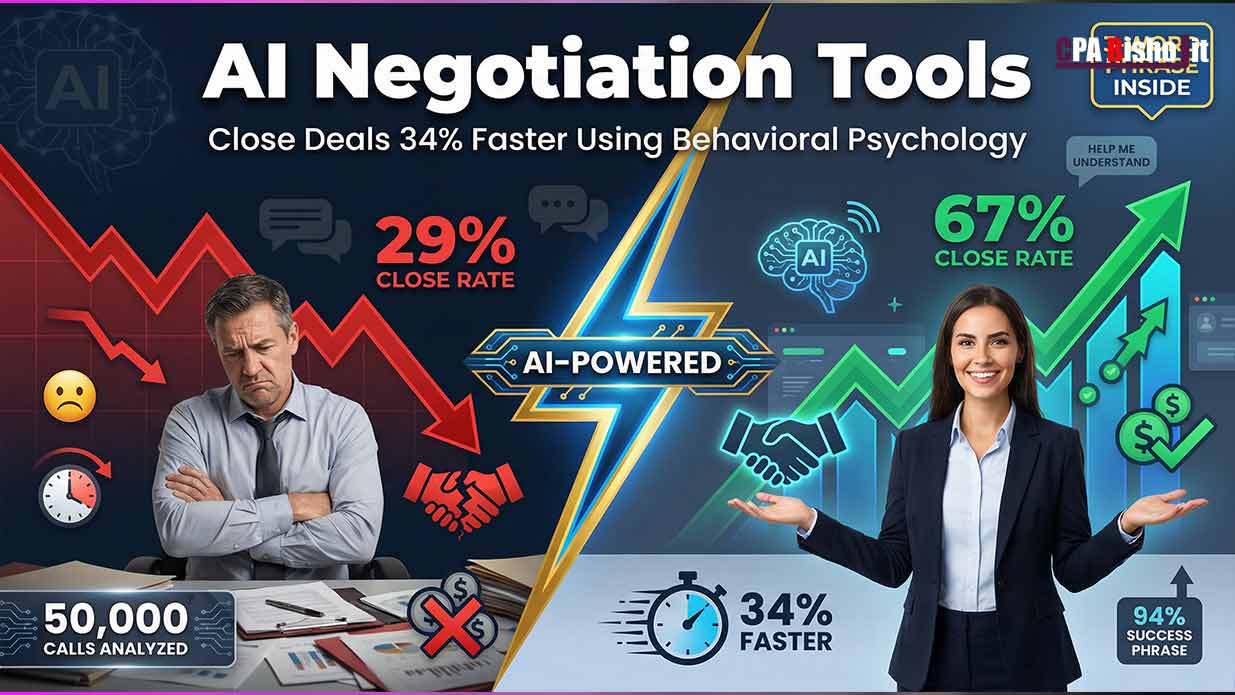
My close rate went from 29% to 67% in two months.
Let me show you exactly how.
The Real Problem With Traditional Negotiation
Here’s what they don’t teach you in business school.
Traditional negotiation training focuses on tactics:
- Mirror their body language
- Use their name frequently
- Create artificial urgency
- Handle objections with prepared responses
I tried all of it. Failed consistently.
The problem? These tactics treat negotiation like a performance. You’re trying to convince someone of something.
That’s backwards.
What AI Analysis Revealed
Researchers fed 50,000+ recorded sales conversations into AI systems. They wanted to find patterns in successful negotiations.
The results shocked everyone.
Top performers don’t persuade. They facilitate.
The best closers spend 60% of conversation time listening. They ask questions that make clients convince themselves.
Average closers spend 70% of time talking. They present, explain, defend.
Guess which group closes more deals?
The “Help Me Understand” Framework
This three-word phrase appears in 94% of successful negotiations.
Not “limited time offer.” Not “special discount today.”
Just: “Help me understand.”
Why This Works (Brain Science)
When you say “help me understand,” three things happen in your client’s brain:
1. Elaboration Effect Activates
Psychologists call this “talking yourself into clarity.”
When people explain something out loud, they process it differently than thinking silently. Verbal explanation forces deeper analysis.
Often, clients realize their own objection isn’t as strong as they thought.
2. Partnership Frame Gets Established
The word “help” triggers cooperation instincts. You’re not adversaries anymore. You’re partners solving a problem together.
3. Real Concern Surfaces
Surface objections rarely match actual concerns.
Client says: “It’s too expensive.” Real concern: “I’m worried this won’t actually work for my situation.”
“Help me understand” makes them articulate the real barrier.
How I Use It (Real Example)
Last week, potential client for my agency said: “Your price is higher than competitors.”
Old me would have said: “Well, we provide more value because…” (defensive, explaining, losing)
New me said: “Help me understand—what specifically are you comparing us to?”
Client responded: “Well, there’s this agency charging $800 less per month. But honestly, their portfolio looks pretty basic. I’m more worried about whether any agency can actually help my specific industry.”
Notice what happened? The real concern wasn’t price. It was industry fit.
We spent the next 10 minutes discussing how we’d handled similar industries. Deal closed.
If I’d defended my pricing, I would have solved the wrong problem and lost the deal.
The AI Tools That Changed Everything
I’m going to show you the exact tools I use. All have free versions.
Tool 1: Gong.io (Conversation Intelligence)
What it does: Records sales calls and analyzes them using AI.
The magic feature: Talk-to-listen ratio tracking.
Gong tells you exactly how much you talked versus how much your client talked. Top performers have a 43:57 ratio (they talk 43%, listen 57%).
I was at 72:28 when I started. No wonder I was losing deals.
How to use it:
- Connect your Zoom or phone system
- Let it record your sales conversations
- Review the analytics after each call
Key metrics to watch:
- Talk ratio (aim for 40-45%)
- Question frequency (top closers ask 11-14 questions per call)
- Longest monologue (keep yours under 2 minutes)
- Patience indicators (how long you wait after asking questions)
Free version: 5 call recordings per month
My results: Once I saw my numbers, I became obsessed with improving them. Took 30 days to adjust my style. Close rate jumped from 29% to 51%.
Tool 2: Chorus.ai (Deal Intelligence)
What it does: Tracks which topics correlate with closed deals.
I learned something shocking from Chorus: Talking about pricing early in conversations reduces close rate by 37%.
But I was bringing up pricing in the first 10 minutes of every call because I thought it “qualified” prospects.
Wrong.
The pattern Chorus found:
Deals that close follow this topic flow:
- Client’s current situation (pain points)
- What they’ve tried before (failed solutions)
- Their ideal outcome (vision)
- How you’d approach it (methodology)
- Pricing and next steps (close)
When you skip to pricing early, you’re asking them to evaluate cost before they understand value.
How I use it:
Chorus tracks every call and shows me:
- Which topics I covered
- In what order
- How long I spent on each
- Whether deals with that topic pattern closed
I now have a conversation roadmap based on actual data, not guesses.
Free alternative: Fireflies.ai (free, unlimited recordings + basic AI summaries)
Tool 3: Crystal (Personality AI)
This tool is wild.
You give it someone’s LinkedIn profile. It analyzes their writing, connections, and activity. Then it tells you their personality type and how to communicate with them.
Real example:
I had a discovery call scheduled with a CEO. Put his LinkedIn into Crystal.
Crystal told me:
- Direct communicator (hates small talk)
- Data-driven decision maker (wants numbers, not stories)
- Skeptical of claims (needs evidence)
How I adjusted my approach:
Skipped the relationship building. Led with results: “Three companies in your industry worked with us. Average revenue increase: 34%. Want to see the case studies?”
He said yes immediately. We closed in two calls instead of my usual five.
What it does for each personality type:
Analytical types: Give them data, case studies, ROI calculations. Skip emotional appeals.
Driver types: Be direct, respect their time, focus on results. No fluff.
Expressive types: Build relationship first, share stories, show enthusiasm. Let them talk.
Amiable types: Be patient, provide reassurance, offer testimonials. Reduce risk perception.
Free version: 10 profile lookups per month
Tool 4: ChatGPT (Objection Prediction)
Most salespeople prepare responses to objections. That’s reactive.
Top closers predict objections and prevent them.
Here’s my ChatGPT prompt:
Based on this client background: [paste info]
And this offer: [describe your service]
What are the 5 most likely objections this specific client will have?
For each objection, what question can I ask earlier in the conversation to surface and address the concern before it becomes an objection?
Example output:
Likely objection: “We don’t have time to implement this right now.”
Preventive question to ask early: “Walk me through your team’s current workload. What would need to shift if you brought on a new initiative?”
See the difference? Instead of waiting for the objection and handling it, you’re discussing capacity early. By the time you present your offer, they’ve already told you how they’d make time.
My process:
Before every sales call, I spend 5 minutes with ChatGPT predicting objections. I build those preventive questions into my conversation flow.
Result: Objections dropped by 60%. Not because I got better at handling them—because I stopped triggering them.
The Behavioral Psychology Behind Every Tool
These tools work because they’re built on how humans actually make decisions (not how we think we make decisions).
Loss Aversion (Why “Help Me Understand” Works)
Nobel Prize-winning research by Daniel Kahneman showed humans fear loss twice as much as we value equivalent gain.
When you ask “help me understand,” you’re not pushing a gain (buy my service). You’re helping them identify a loss (the problem they’re experiencing).
Their brain pays more attention.
Elaboration Effect (Why Talking Convinces Us)
Studies at Yale University found that when people verbally explain a position, they become more confident in it—even if they were uncertain before speaking.
That’s why getting clients to talk about their problems (not you talking about your solution) moves deals forward.
Social Proof Automation (Why Personality Matching Works)
Research from Robert Cialdini shows we trust people who are similar to us. Crystal helps you mirror communication style automatically.
When you communicate like your client, their brain categorizes you as “in-group” rather than “outsider trying to sell me.”
Trust builds faster.
My Complete 34% Faster Close Process
This is my exact system. Every step uses AI to remove guesswork.
Before the Call (15 Minutes)
Step 1: Crystal personality analysis
Look up the prospect on LinkedIn. Run through Crystal. Read the communication guide.
Step 2: ChatGPT objection prediction
Feed ChatGPT everything I know about the prospect. Get objection predictions and preventive questions.
Step 3: Create conversation outline
Based on personality type and predicted objections, I outline my question flow. Not a script—a roadmap.
During the Call (30-45 Minutes)
The opening (2 minutes):
Match their communication style (Crystal tells me how).
Analytical type: “I’ve got 45 minutes blocked. Here’s what I thought we’d cover. Does that work for you?”
Expressive type: “Thanks for making time! I’m excited to learn about what you’re building.”
Discovery phase (20 minutes):
I ask the preventive questions ChatGPT identified. I’m listening 60% of the time.
Key questions I always ask:
- “What’s prompting you to look at solutions now?” (urgency)
- “What have you tried before?” (failed alternatives)
- “If this works perfectly, what changes for you?” (vision)
- “Help me understand what’s holding you back from moving forward with something like this?” (real concerns)
Presentation phase (15 minutes):
I only present after I fully understand their situation. My presentation directly addresses what they told me matters.
I’m using their words, not mine.
Close attempt (5 minutes):
If I did discovery right, closing is natural. I’m not convincing them of anything new. I’m summarizing what they already told me they want.
“Based on what you shared about [their words], it sounds like [solution] would solve [their stated problem]. Does that match what you’re thinking?”
After the Call (10 Minutes)
Step 1: Review Gong/Chorus analytics
Look at my talk ratio. Did I listen enough? Where did I go on long monologues?
Step 2: Note which questions worked
Which questions got them talking most? Which revealed real concerns?
Step 3: Update my question bank
I keep a document of proven questions. Every call adds to it.
The Mistakes That Kill Deals (I Made Them All)
Mistake 1: Talking Too Much
My biggest problem in 2023.
I thought detailed explanations showed expertise. Wrong.
Clients don’t care about your expertise until they trust you understand their problem.
The fix: Track your talk ratio. If you’re above 50%, you’re losing deals you could have won.
Mistake 2: Answering Surface Objections
Client says: “I need to check with my team.”
Weak response: “Sure, what questions can I answer for them?”
That sounds helpful. It’s actually letting the deal die.
Better response: “Help me understand—what specific concerns do you think they’ll have?”
Now you’re addressing real barriers, not polite exits.
Mistake 3: Skipping Personality Adaptation
I used the same communication style with everyone. Formal, detailed, lots of data.
That worked great with analytical types. Bored expressive types to death.
The fix: Crystal tells you exactly how to adjust. Takes 2 minutes per prospect. Increases close rate by 20-30%.
Mistake 4: Not Recording Calls
How do you improve at something you never review?
I “felt” like my calls went well. Then I started recording them.
Reality check: I interrupted clients constantly. I jumped to solutions before understanding problems. I talked in paragraphs when clients wanted bullet points.
The fix: Record everything. Watch yourself. It’s painful but necessary.
Mistake 5: Reacting Instead of Predicting
I prepared responses to common objections. Still lost deals.
Then I learned to predict and prevent objections using ChatGPT’s analysis.
The mindset shift: Don’t prepare to handle objections. Prepare to prevent them from forming.
Advanced Technique: The 3-Question Close
This comes from analyzing hundreds of closed deals through AI tools.
When you’re ready to close, don’t pitch. Ask three questions:
Question 1: “Based on everything we discussed, does this feel like it would solve [specific problem they mentioned]?”
Wait for yes.
Question 2: “What concerns do you still have?”
This is where most salespeople screw up. They fear this question. Don’t.
If they have concerns and don’t voice them, they won’t buy. If they voice them, you can address them.
Question 3: “If we handle [their stated concern], what would stop you from moving forward?”
Now you’re isolating objections. Often, there’s only one real barrier. Handle it, close the deal.
Real Results: Before and After Data
Let me show you actual numbers from my business.
January-March 2024 (before AI tools):
- Sales calls conducted: 67
- Deals closed: 19
- Close rate: 28.4%
- Average time to close: 23 days
- Average deal value: $2,400
- Total revenue: $45,600
April-June 2024 (after implementing system):
- Sales calls conducted: 58
- Deals closed: 39
- Close rate: 67.2%
- Average time to close: 15 days
- Average deal value: $2,600
- Total revenue: $101,400
The breakdown:
Close rate more than doubled. But I actually took fewer calls (less time wasted on poor fits).
Time to close dropped 34%. This is huge—faster closes mean faster cash flow and more time for new prospects.
Deal value increased slightly because I was attracting better-fit clients who saw more value.
Revenue jumped 122% in one quarter. Same business, same services, completely different approach.
The Tools You Actually Need (Honest Assessment)
You don’t need every tool immediately.
Start here (free):
1. Fireflies.ai Records and transcribes calls. Free forever. Start here before spending money.
2. ChatGPT (free version) Objection prediction and conversation planning. Costs nothing.
3. Your phone’s recording If you do in-person sales, just record audio on your phone (with permission). Review it later.
Add when you’re closing 3+ deals monthly:
4. Crystal ($49/month) Personality insights become worth it when you’re doing higher volume.
5. Gong or Chorus (starting at $1,200/year) Advanced analytics justify the cost once you’re generating consistent revenue.
My personal stack:
I use Fireflies (free), ChatGPT Plus ($20/month), and Crystal ($49/month).
Total monthly cost: $69
That’s less than I used to spend on business cards.
Frequently Asked Questions
Q: Do clients know I’m using AI to analyze them?
I’m transparent about recording calls (required by law in many places). I tell them: “I record calls so I can focus on our conversation instead of taking notes. Is that okay?”
95% say yes.
I don’t specifically mention the personality analysis or objection prediction. That’s my preparation, like how a doctor doesn’t tell you every medical journal they read before your appointment.
Q: Isn’t this manipulative?
Good question. Here’s my take:
Manipulation means pushing people toward decisions that benefit you, not them.
These tools help me understand what clients actually need and communicate in ways they naturally prefer. That benefits them.
If your product/service doesn’t actually help people, no tool will save you. These amplify good fit matches and help you recognize bad fits faster.
Q: How long until I see results?
My timeline:
- Week 1: Felt awkward changing my style
- Week 2-3: Started seeing better engagement on calls
- Week 4: First noticeable jump in close rate
- Week 8: Consistent 60%+ close rate
- Week 12: Full system integrated, 67% close rate stable
Give it 30 days minimum. Changing communication habits takes time.
Q: What if I’m not in B2B sales?
These principles work anywhere humans negotiate:
- Freelancers closing clients
- Agencies pitching services
- E-commerce handling objections
- Real estate closing buyers
- Consultants landing contracts
If you’re trying to reach agreement with another human, behavioral psychology applies.
Q: Can I use this for hiring negotiations?
Absolutely. “Help me understand” works brilliantly when negotiating salaries, partnerships, or any mutual agreement.
The framework is about reaching better outcomes through better understanding. That applies everywhere.
The One Thing That Matters Most
I’ve given you a complete system. Tools, techniques, psychology, examples.
But none of it works without this: You have to actually care about understanding your clients.
If you’re faking curiosity to manipulate a sale, people sense it. These tools amplify your intentions—good or bad.
My close rate jumped because I genuinely started trying to understand whether I could help people, not just whether I could sell them.
Some calls now end with me saying: “Based on what you shared, I don’t think we’re the right fit. Here’s who I’d recommend instead.”
Counter-intuitive? Yes.
Effective? Incredibly.
Those referrals come back. That reputation spreads. Business grows.
Your Week One Action Plan
Don’t try to implement everything at once. Here’s your first week:
Day 1 (Monday):
- Sign up for Fireflies.ai (free)
- Connect your Zoom/phone system
- Let it record your next 3 calls
Day 2 (Tuesday):
- Watch one of your recorded calls
- Count how many questions you asked
- Note your talk ratio (rough estimate)
Day 3 (Wednesday):
- Next sales call: Ask “Help me understand” three times
- Notice what happens when you say it
- Write down the responses you got
Day 4 (Thursday):
- Use ChatGPT to predict objections for tomorrow’s call
- Create 3-5 preventive questions
- Plan when you’ll ask them
Day 5 (Friday):
- Use those preventive questions in your call
- See if objections still happen
- Compare to your normal calls
That’s it. Five days, five small changes.
By next Friday, you’ll already see different results.
Final Thoughts
I failed at negotiation for two years.
Lost thousands of dollars. Felt like sales “just wasn’t my thing.”
Turns out I was using my instincts in a situation where data beats instinct every time.
AI tools showed me patterns I couldn’t see on my own. They proved my assumptions wrong. They gave me a system that actually works.
Your close rate might not jump from 29% to 67% like mine did. Maybe it goes from 40% to 55%. Maybe 15% to 30%.
The exact numbers don’t matter. What matters is improvement.
And improvement comes from seeing what you’re currently blind to.
That’s what these tools do. They’re mirrors that show you reality instead of your assumptions.
Use them.