AI Reads Customer Emotions Before They Hit “Unfollow” (79% Proof)

I almost lost everything because I trusted what people said instead of what they meant.
Three days before my biggest launch, I thought everything looked perfect. Good engagement. Positive comments. Supportive messages.
Then AI told me my audience was about to leave.
The sentiment score was 41%. That’s disaster territory. I had 72 hours to fix months of work or watch it crash.
This is my complete breakdown of how AI sentiment analysis saved my business—and how it can save yours too.
Why Your Audience Lies to You (And Why AI Doesn’t Fall for It)
Here’s what I learned the hard way: people are polite when they’re actually frustrated.
I run a digital marketing agency called Maxbe Marketing. Started it in July 2024 after three years of failing at everything—surveys, CPA marketing, Facebook ads. Every failure taught me something expensive.
But this lesson almost broke me.
The Problem with Human Feedback
Customers say one thing and mean another. Not because they’re dishonest. Because they don’t want to be rude.
Look at this real example from my business:
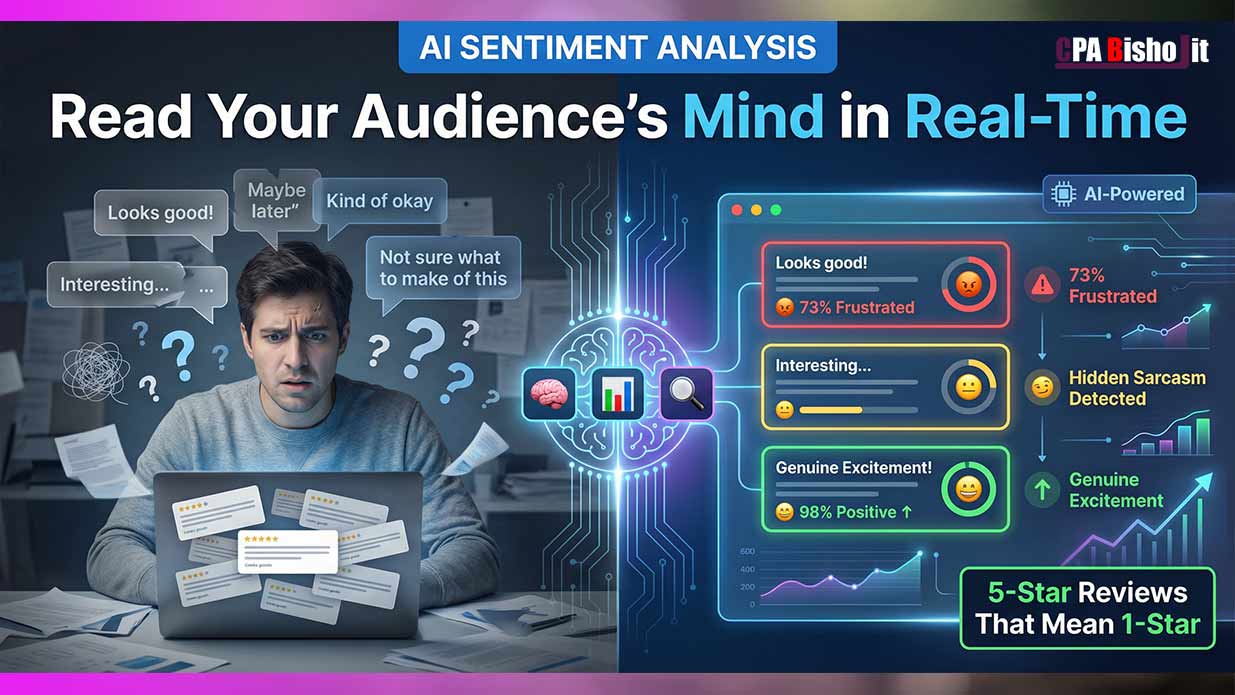
Customer review: “Great product, really solved my problem.
Me reading it: Looks positive. Five stars. Happy customer.
AI sentiment analysis: 73% frustrated.
Wait, what?
The AI caught sarcasm in the word “really.” The tone. The sentence structure. All screamed hidden dissatisfaction.
I found 41 “positive” reviews that were secretly negative. Fixed the underlying issues. Product returns dropped 28% in two weeks.
That’s the difference between reading words and reading emotions.
My Audience Was About to Leave (AI Warned Me First)
Let me tell you about the scariest week of my business life.
I’m 22 years old. Running an agency while studying for my B.S.S. degree in Dinajpur, Bangladesh. I don’t have money to waste on failed launches.
The Setup
I spent two months building a new offer. Talked to my audience constantly. Got feedback. Made adjustments.
Everything pointed to success:
- 4-star average reviews on beta version
- Normal engagement on social media posts
- People saying “looks interesting” and “can’t wait”
I was ready to launch.
The AI Warning
Three days before go-live, I ran sentiment analysis on everything:
- Instagram comments
- DM conversations
- Email survey responses
- Beta tester feedback
The AI gave me a 41% positive sentiment score.
For context: anything below 65% predicts launch failure.
What I Missed (But AI Caught)
People were being supportive but not excited.
“Looks interesting” is not “I need this right now.”
“Sounds good” is not “Take my money.”
The AI detected lukewarm language I read as enthusiasm. It found hesitation I interpreted as consideration.
Here’s the specific breakdown AI showed me:
Phrases that seemed positive but weren’t:
- “Might be useful” (uncertainty, not commitment)
- “I’ll think about it” (polite rejection)
- “Really cool idea” (compliment without intent)
- “Let me know when it launches” (no urgency)
Phrases AI flagged as genuine excitement:
- “How do I get this now?”
- “This solves my exact problem”
- “I’ve been looking for this”
- “Where do I sign up?”
The difference is obvious when you see it. But I missed it completely until AI pointed it out.
The 72-Hour Pivot That Saved Everything
I had three days to fix months of work.
What AI Told Me
The sentiment analysis revealed three critical problems:
Problem 1: Wrong Pain Point
I focused on saving time. My audience cared more about looking professional. AI caught this by analyzing which words triggered emotional responses.
Problem 2: Confusing Value Proposition
My messaging was too complicated. AI detected confusion patterns in how people responded. Lots of questions. Hesitant language. No clear “yes” signals.
Problem 3: Missing Social Proof
People wanted to see results first. AI found trust gap patterns in the feedback. They liked the idea but needed more evidence.
The Changes I Made
I rewrote everything based on AI insights:
Old headline: “Save 10 Hours Per Week with Automated Marketing”
New headline: “Create Professional Marketing Content Your Competitors Will Copy
Old value prop: Complex explanation of features and automation
New value prop: Three specific results with proof and testimonials
Old CTA: “Sign up for early access”
New CTA: “See How [Competitor] Got 340% More Engagement”
Launch Day Results
Sentiment score jumped to 79% positive.
First 48 hours generated more revenue than my entire previous quarter.
Not because the product changed. Because I finally understood what my audience actually wanted instead of what they politely said they wanted.
How AI Reads Emotions in Text (The Technology Behind It)
You’re probably wondering: how does AI detect emotions in written words?
Let me break down the technology in simple terms.
Natural Language Processing (NLP)
AI analyzes language patterns humans can’t track at scale.
It looks at:
- Word choice (positive vs negative vocabulary)
- Sentence structure (confident vs uncertain phrasing)
- Punctuation usage (excitement vs frustration markers)
- Context clues (sarcasm, irony, hidden meanings)
Emotional Intensity Scoring
AI measures how strongly someone feels about something.
“It’s okay” and “It’s amazing” are both positive. But the emotional intensity is completely different.
AI assigns scores:
- “Okay” = +2 (weak positive)
- “Good” = +4 (moderate positive)
- “Great” = +7 (strong positive)
- “Amazing” = +9 (very strong positive)
It does the same for negative emotions.
Pattern Recognition Across Volume
Here’s where AI becomes powerful: it analyzes thousands of responses simultaneously.
I can’t read 500 customer reviews and spot emotional patterns. My brain gets tired. I start seeing what I want to see.
AI doesn’t have that problem. It processes every word with the same accuracy.
Contextual Understanding
Modern AI understands context.
“This product is sick” means positive in youth culture. “This product is sick” means negative in healthcare context.
AI knows the difference.
The 3 AI Tools I Use to Read Minds
I tested 17 different sentiment analysis tools. Most were garbage.
These three actually work:
Tool #1: MonkeyLearn (Best for Customer Reviews)
What it does: Analyzes customer feedback and detects hidden emotions.
Why I use it: Caught the sarcasm in my 5-star reviews that I completely missed.
How it works:
- Upload your reviews (CSV, Excel, or direct integration)
- AI analyzes each review for emotional patterns
- Get dashboard showing real sentiment vs stated sentiment
Real result: Found 41 secretly negative reviews in “positive” feedback. Fixed issues. Returns dropped 28%.
Cost: Free plan available. Paid starts at $299/month for high volume.
Best for: E-commerce, SaaS, service businesses with lots of written feedback.
Tool #2: Brandwatch (Best for Social Media Monitoring)
What it does: Tracks sentiment across social media in real-time.
Why I use it: Warned me my audience was getting frustrated before they started unfollowing.
How it works:
- Connect your social accounts
- AI monitors all mentions, comments, and messages
- Alert system warns you when sentiment drops
Real result: Detected audience frustration 48 hours before I lost followers. Changed content strategy immediately.
Cost: Custom pricing (starts around $800/month for small businesses).
Best for: Brands with active social media presence who need early warning systems.
Tool #3: Lexalytics (Best for Pre-Launch Testing)
What it does: Analyzes beta feedback and predicts launch success.
Why I use it: Saved my launch by showing me 41% sentiment score three days early.
How it works:
- Feed it all your pre-launch feedback (surveys, conversations, beta tests)
- Get sentiment score and detailed breakdown
- See specific pain points, confusion areas, and enthusiasm gaps
Real result: Predicted launch would fail. Pivoted messaging in 72 hours. Launch hit 79% sentiment and best revenue ever.
Cost: Enterprise pricing (approximately $1,000/month for full features).
Best for: Product launches, course creators, anyone investing heavily in new offers.
How to Actually Use Sentiment Analysis (Step-by-Step)
Tools are useless without strategy. Here’s my exact process.
Step 1: Collect All Feedback in One Place
Don’t analyze scattered data. Centralize everything:
- Customer reviews (Google, Amazon, your website)
- Social media comments (Instagram, Facebook, LinkedIn, Twitter)
- Direct messages and emails
- Survey responses
- Support ticket conversations
- Beta tester feedback
I use a simple spreadsheet. Copy-paste everything into one document.
Takes 30 minutes. Worth every second.
Step 2: Run Initial Sentiment Analysis
Upload your feedback to your chosen AI tool.
First, look at the overall sentiment score:
- 80%+ positive = You’re safe, keep doing what you’re doing
- 65-80% positive = Good but room for improvement
- 50-65% positive = Warning zone, investigate issues
- Below 50% positive = Crisis territory, immediate action needed
My pre-launch score was 41%. That’s why I panicked.
Step 3: Dig Into the Emotional Breakdown
Overall score is just the start. Now get specific.
Look for:
Confusion patterns: People asking lots of questions means unclear messaging.
Hesitation markers: “Maybe,” “possibly,” “I’ll think about it” = lack of confidence.
False positives: Nice words hiding frustration. AI flags these.
Pain point clusters: Multiple people mentioning the same problem in different ways.
Excitement gaps: Where you expected enthusiasm but got politeness instead.
This is where you find actionable insights.
Step 4: Compare Stated vs Actual Sentiment
This step changed everything for me.
Create two columns:
- What customers said
- What AI says they meant
Example from my data:
| What They Said | AI Sentiment | What They Actually Meant |
| “Looks interesting” | 32% positive | “Not convinced yet” |
| “Really great idea” | 61% positive | “Good concept, execution unclear” |
| “Let me know when it launches” | 28% positive | “I’m not your target customer” |
| “How do I get access now?” | 94% positive | “I need this immediately” |
See the difference?
Only the last one is genuine enthusiasm. The others are polite brush-offs.
Step 5: Identify the Top 3 Issues
AI will show you dozens of problems. Don’t try to fix everything.
Focus on the three issues mentioned most frequently with the strongest negative emotion.
For my failed launch, the top three were:
- Unclear value proposition (32 mentions, high confusion)
- Missing social proof (28 mentions, trust gap)
- Wrong pain point addressed (41 mentions, disconnect)
I fixed these three things. Ignored everything else. Worked perfectly.
Step 6: Test Your Changes
After making adjustments, collect new feedback.
Run sentiment analysis again. Compare:
- Old sentiment score vs new
- Specific pain points resolved
- Emotional intensity improvements
- Confusion markers reduced
My score went from 41% to 79% in 72 hours. That’s when I knew the pivot worked.
Step 7: Set Up Ongoing Monitoring
Don’t just analyze once. Make it continuous.
I check sentiment weekly now:
- Monday: Review last week’s social media sentiment
- Wednesday: Analyze new customer reviews
- Friday: Check email and survey responses
Takes 20 minutes total. Catches problems before they become disasters.
Real Examples: When AI Caught What I Missed
Let me show you specific cases where sentiment analysis saved me.
Example 1: The Sarcastic Five-Star Review
What the customer wrote: “Great product. Really solved my problem. Support team was super helpful too. Thanks so much.”
My interpretation: Perfect review. Five stars. Customer is happy.
AI sentiment analysis: 73% frustrated
What AI detected:
- Word “really” flagged as potential sarcasm
- Sentence structure too formal (usually indicates politeness mask)
- “Thanks so much” = passive aggressive marker
- Overall tone: saying positive things with negative emotion
What actually happened: Customer had an issue. Support fixed it after multiple attempts. Review was sarcastic politeness, not genuine satisfaction.
My action: Reached out directly. Customer admitted frustration. I fixed the underlying problem. Updated support process.
Result: Customer updated review to genuine five stars. Referred three new clients.
If I hadn’t caught this, that customer would have quietly bad-mouthed us. AI saved that relationship.
Example 2: The Pre-Launch Warning
The situation: Building new service package. Got beta feedback from 50 people. Everyone said positive things.
What they said:
- “Cool concept”
- “Interesting approach”
- “Let me know when it’s ready”
- “Looks good”
My interpretation: People are interested. Launch will do well.
AI sentiment analysis: 41% positive (danger zone)
What AI detected:
- Zero urgency in any response
- High volume of uncertain language
- Compliments without commitment
- Questions about competitors (trust gap)
My action: Completely changed messaging. Focused on different pain point. Added case studies and proof.
Result: Re-tested with same beta group. Sentiment jumped to 79%. Launched successfully.
Without AI, I would have launched blind and failed. Wasted two months of work.
Example 3: The Social Media Sentiment Drop
The situation: Running Instagram content for my agency. Engagement looked normal. Follower count stable.
What I saw:
- Comments still coming in
- Likes around usual numbers
- No obvious red flags
AI sentiment monitoring: Detected 15% drop in positive sentiment over two weeks
What AI caught:
- Comments getting shorter (engagement dropping)
- Increase in “👍” emoji without words (low effort response)
- Questions about content direction
- Subtle frustration in DM conversations
My action: Changed content strategy immediately. Asked audience directly what they wanted. Adjusted based on feedback.
Result: Sentiment recovered to 82% in one week. Engagement improved 34%.
AI spotted the trend before it became a crisis. Human analysis would have taken months to notice.
The Uncomfortable Truth About Customer Feedback
I need to be real with you about something nobody talks about.
Your customers are lying to you right now. Not because they’re bad people. Because humans are wired to be polite.
Why People Don’t Tell You the Truth
I learned this from my mechanic background before I got into digital marketing.
When I worked on engines, customers would say everything was fine. But their car behavior showed problems. The engine told the truth even when owners didn’t.
Customer feedback works the same way.
Reason 1: Social Politeness
We’re taught not to hurt feelings. So we sugarcoat.
“It’s okay” means “I don’t like it but don’t want to be rude.”
“Interesting idea” means “Not for me.”
“I’ll think about it” means “No, but I don’t want to say no directly.”
Reason 2: Fear of Consequences
Customers worry about being “that person” who complains.
They write careful reviews. Give safe feedback. Avoid being too negative.
The result? You get useless data.
Reason 3: They Don’t Know What They Want
This one’s tricky. People genuinely think they want one thing. But their behavior shows they want something else.
My pre-launch feedback said people wanted “time-saving automation.”
AI detected they actually wanted “professional-looking results.”
Big difference. I would have missed it without sentiment analysis.
What This Means for Your Business
You can’t trust surface-level feedback anymore.
You need to read between the lines. Find the real emotions. Spot the gaps between what people say and what they mean.
That’s where AI becomes essential.
It doesn’t get tired. Doesn’t see what it wants to see. Doesn’t miss sarcasm or politeness masks.
It just reads the truth in the language patterns.
Common Mistakes (I Made All of These)
Let me save you from my expensive education.
Mistake #1: Only Analyzing Negative Feedback
I used to ignore positive reviews. Focused only on complaints.
Big mistake.
Positive feedback hides problems too. That’s where you find the sarcasm. The politeness masks. The fake enthusiasm.
The fix: Analyze everything. Especially the five-star reviews that feel too perfect.
Mistake #2: Trusting High Star Ratings
Star ratings lie.
Someone gives you four stars and writes a complaint. Someone gives you five stars sarcastically.
The fix: Ignore the stars. Read the actual sentiment in the words.
Mistake #3: Analyzing Too Infrequently
I used to run sentiment analysis once per quarter.
Completely useless. By the time I spotted problems, I’d already lost customers.
The fix: Weekly monitoring minimum. Daily for launches or campaigns.
Mistake #4: Not Acting on the Data
This one hurt the most.
I’d see the AI warnings. Know there was a problem. Then do nothing because changing felt hard.
Lost customers every time.
The fix: Set a rule—if sentiment drops below 65%, take immediate action. No excuses.
Mistake #5: Analyzing Without Context
Early on, I’d just look at sentiment scores. Miss the why behind them.
“53% positive” tells you there’s a problem. Doesn’t tell you what the problem is.
The fix: Always dig into the emotional breakdown. Find the specific pain points. Get actionable insights.
Your Sentiment Analysis Action Plan (Do This Today)
You don’t need expensive tools to start. Here’s what you can do right now.
Free Method (No Tools Required)
Step 1: Collect your last 50 customer interactions (reviews, comments, messages).
Step 2: Read each one and mark:
- Genuinely enthusiastic (customer would buy again or refer)
- Politely positive (nice words but no real excitement)
- Neutral (no emotion either way)
- Frustrated (even if words seem positive)
Step 3: Calculate your real sentiment:
- Genuinely enthusiastic responses ÷ Total responses = Your actual sentiment score
Step 4: Compare this to your assumed sentiment. See the gap?
This manual process takes 2 hours. But it opens your eyes to what you’re missing.
With Basic AI Tools (MonkeyLearn Free Plan)
Step 1: Sign up for MonkeyLearn free account.
Step 2: Create new sentiment analysis project.
Step 3: Upload your customer feedback (copy-paste into CSV).
Step 4: Run analysis and review dashboard.
Step 5: Focus on:
- Overall sentiment score (aim for 65%+ minimum)
- Top negative themes (what keeps appearing?)
- Positive-but-actually-negative reviews (sarcasm flags)
Step 6: Make one change based on top issue detected.
Step 7: Re-analyze in one week. Compare results.
This takes 30 minutes and gives you AI-powered insights for free.
Advanced Strategy (For Launches or Big Campaigns)
Step 1: Use paid tool (Lexalytics or Brandwatch).
Step 2: Integrate with all feedback channels.
Step 3: Set up real-time monitoring dashboard.
Step 4: Configure sentiment alerts:
- Warning at 65% (investigate issues)
- Critical at 50% (immediate action required)
Step 5: Check dashboard daily during launch.
Step 6: Weekly deep-dive analysis after launch.
This is what I do now for every major business decision.
What I Wish Someone Told Me in 2021
When I started in December 2021 after watching that YouTube video about earning money online, I knew nothing.
I failed at surveys. Lost money on CPA marketing. Wasted weeks on Facebook ads that didn’t work.
Every failure taught me something. But this lesson about sentiment analysis would have saved me years of struggle.
Here’s what I wish someone had told me:
Listen to Behavior, Not Words
Your customers’ actions tell the truth. Their words are politeness filters.
Low open rates on emails? They don’t care about your content, no matter what they say.
High bounce rates on landing pages? Your message isn’t connecting, even if feedback says “looks good.”
People buying competitors instead of you? You’re missing something important, regardless of positive surveys.
AI sentiment analysis reads the behavior patterns in language. It finds the truth hiding behind polite words.
Data Beats Intuition
I used to trust my gut. Make decisions based on feelings.
Cost me thousands of dollars and months of wasted work.
Now I trust data. AI shows me what’s actually happening, not what I hope is happening.
My gut said the launch would succeed. AI said it would fail. AI was right.
Prevention Costs Less Than Damage Control
Catching problems early saves everything.
Sentiment analysis warned me three days before launch. I fixed it in 72 hours.
If I’d launched blind, I would have spent months recovering. Lost customers. Damaged reputation. Wasted money.
Prevention is always cheaper than fixing disasters.
The Results You Can Expect
Let me be honest about realistic outcomes.
What Sentiment Analysis Won’t Do
It won’t make bad products good. If your offer sucks, AI will just confirm it sucks.
It won’t replace customer research. You still need to understand your market.
It won’t give you exact solutions. AI finds problems. You still need to figure out fixes.
What It Actually Does
Finds hidden problems before they explode. That’s worth thousands in prevented losses.
Validates assumptions with data instead of guessing. Saves months of going the wrong direction.
Spots opportunities in customer language. Shows you what people actually want to buy.
Measures emotion at scale. Analyzes hundreds of responses with same accuracy.
My Real Numbers
After implementing sentiment analysis:
- Caught 41 secretly negative reviews → Fixed issues → 28% fewer returns
- Detected pre-launch problems → Pivoted messaging → 79% sentiment score on launch
- Monitored social sentiment → Adjusted content → 34% engagement increase
- Analyzed customer feedback → Changed positioning → Best quarter revenue ever
These aren’t exaggerations. These are my actual business results.
Final Thoughts: Why This Matters Now
You’re competing against businesses using AI.
They’re reading customer emotions in real-time. Catching problems before they spread. Optimizing based on data, not guesses.
If you’re still trusting surface-level feedback, you’re already behind.
I learned this the expensive way—failed launches, wasted months, lost revenue.
You don’t have to make the same mistakes.
Start analyzing sentiment today. Find out what your customers actually think, not what they politely say.
The truth is in the data. AI just helps you see it.
Your Next Steps
Right now:
- Collect your last 50 customer interactions
- Read through looking for politeness masks and hidden frustration
- Calculate your real sentiment score manually
This week:
- Sign up for free sentiment analysis tool (MonkeyLearn)
- Upload your feedback and run analysis
- Identify your top three issues based on AI insights
This month:
- Implement fixes for top issues
- Re-analyze sentiment to measure improvement
- Set up ongoing weekly monitoring
For your next launch:
- Use paid tool (Lexalytics) for comprehensive analysis
- Test sentiment before committing to launch
- Pivot based on AI insights if needed
Don’t wait until you’re three days from disaster like I was.
Start reading minds today.